
What Is a Call Center?
A call center is a combination of people, processes, and technologies created to manage communication between an organization and its customers. These interactions may include inbound calls from customers, outbound calls from the organization, text messages, live chat, email, social media, and messaging applications.
In a professional call center, each customer request is recorded, categorized, routed to the right agent, and stored for future follow-up. A call center is therefore more than a place where employees answer phones; it is an important part of customer experience management, sales, service, and support operations.
Call Center vs. Contact Center
The terms “call center” and “contact center” are sometimes used interchangeably, but they are not exactly the same. A traditional call center mainly focuses on telephone calls, while a contact center manages a wider range of communication channels.
Feature | Call Center | Contact Center |
Primary channel | Telephone | Telephone, chat, email, SMS, and social media |
Main focus | Managing calls | Managing customer interactions across channels |
Customer data | Often more limited | Unified data across multiple channels |
Customer experience | Primarily phone-based | Integrated and omnichannel |
Types of Call Centers
Inbound Call Center
In an inbound call center, customers contact the organization. The main goal is to answer questions, provide support, register complaints, track orders, or guide customers through a service process.
Technical support for products and services
Answering customer questions
Registering and following up on complaints
Tracking orders, payments, or deliveries
Reservations and appointment scheduling
Outbound Call Center
In an outbound call center, agents contact customers or prospects. These calls are usually made for sales, notifications, surveys, collections, or follow-up activities.
Telesales and service introductions
Following up on sales leads
Payment or contract-renewal reminders
Customer satisfaction surveys
Announcements about events or service changes
Blended Call Center
A blended call center handles both inbound and outbound calls. Many businesses use this model because agents can make outbound calls during quieter periods and answer inbound calls during peak hours.
Cloud-Based and On-Premises Call Centers
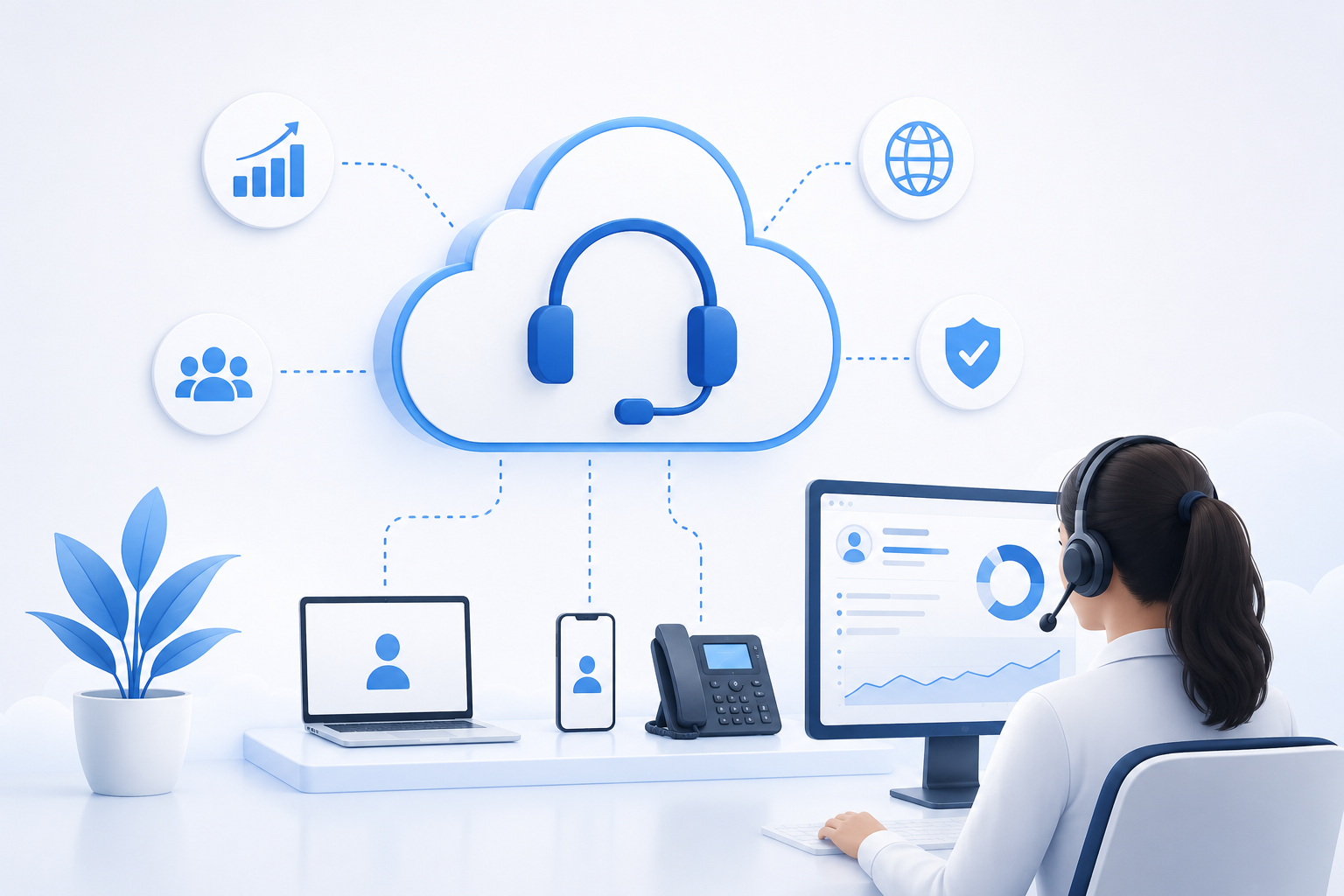
In an on-premises call center, hardware and software are installed and maintained inside the organization. In a cloud-based model, the core infrastructure is delivered over the internet and users connect through a browser or application. Cloud call centers usually offer faster deployment, easier scaling, and better support for remote work, while some organizations prefer on-premises systems because of security, compliance, or infrastructure requirements.
What Are the Main Responsibilities of a Call Center?
Call center responsibilities vary by industry, but they usually include several core activities:
Responding quickly and accurately to customer requests
Recording contact details and interaction history in CRM software
Routing calls intelligently to the relevant agent or department
Following each request until the issue is fully resolved
Providing information about products, prices, orders, or services
Recording customer feedback, complaints, and suggestions
Supporting sales, renewals, and cross-selling
Preparing management reports on call volume and service quality
Core Components of a Call Center
1. Call Center Agents
Agents or operators communicate directly with customers. Strong communication skills, product knowledge, problem-solving ability, patience, and confidence with call center software are essential.
2. Supervisors and Managers
Supervisors review daily agent performance, monitor queues, assist with difficult interactions, and provide operational reports to management.
3. Telephony and Automatic Call Distribution
An Automatic Call Distributor, or ACD, assigns calls to agents according to rules such as agent skill, language, customer type, working hours, or queue volume.
4. Interactive Voice Response
Interactive Voice Response, or IVR, lets customers use keypad selections or spoken requests to reach the right department. It can also complete routine tasks such as balance checks, order tracking, or reference-number retrieval without an agent.
5. CRM Software
Customer Relationship Management software displays customer profiles, purchase history, messages, calls, and requests in one place. Integrating CRM with the call center gives agents better context before they answer.
6. Call Recording and Quality Assurance
Call recording supports training, quality evaluation, dispute resolution, and compliance checks. Organizations should store and use recordings in accordance with privacy laws and security policies.
7. Dashboards and Reporting
Call center dashboards show data such as inbound call volume, wait times, abandoned calls, agent performance, and customer satisfaction. These insights help managers make better decisions.
How Does a Call Center Work?
A typical inbound call follows these steps:
The customer calls the organization’s support number.
The IVR collects the customer’s request or menu selection.
The call is routed to the appropriate queue based on topic, priority, or skill.
The agent views the customer’s information in the CRM and responds.
The conversation details, outcome, and next actions are recorded.
When necessary, the request is assigned to another department for follow-up.
After the interaction, the customer may receive a satisfaction survey.
Benefits of a Call Center for Businesses
Better Customer Experience and Satisfaction
A call center creates a clear route for receiving and tracking requests. Faster answers, access to customer history, and consistent follow-up reduce confusion and build trust.
Higher Sales and Customer Retention
Agents can follow up on leads, recommend relevant services, and identify customer problems before they lead to cancellation or churn.
Lower Operating Costs
Smart routing, automated responses, knowledge bases, and accurate reporting help organizations use people and technology more efficiently.
Access to Valuable Data
Every interaction provides information about customer needs, concerns, and behavior. Analyzing this data can improve products, sales processes, and service design.
Better Coordination Across Teams
When customer information is stored in one system, sales, support, finance, and operations teams can work together and avoid inconsistent answers.
Important Call Center Performance Metrics
Call center quality should be evaluated with clear performance indicators. Common metrics include:
Metric | Description |
Average Speed of Answer | How long customers wait before an agent answers. |
Average Handle Time | The time spent on the conversation and related after-call work. |
First-Call Resolution | The percentage of issues resolved without another customer contact. |
Call Abandonment Rate | The percentage of callers who hang up before receiving an answer. |
Service Level | The percentage of calls answered within a defined time target. |
Customer Satisfaction | The customer’s satisfaction after receiving service. |
Call Quality Score | The result of evaluating conversations against organizational standards. |
Agent Occupancy | The percentage of time agents spend handling calls or related tasks. |
What Is the Difference Between a Call Center and IVR?
IVR is only one component of a call center. It receives calls, collects initial information, and guides customers, while a full call center also includes agents, telephony, CRM, reporting, quality management, support processes, and workforce management. IVR alone cannot replace a complete call center operation.
The Role of Artificial Intelligence in Call Centers
Artificial intelligence is changing how call centers operate. Intelligent tools can analyze conversations, recognize customer intent, suggest responses, and automate repetitive processes.
Chatbots and voice assistants for automated service
Intent detection using natural language processing
Sentiment analysis and identification of dissatisfied customers
Automatic call summaries and CRM updates
Real-time response and knowledge-base suggestions for agents
Call-volume forecasting and workforce planning
Automated conversation quality evaluation
Successful AI adoption still requires high-quality data, carefully designed processes, and human oversight. Customers should always have access to a human agent for complex, sensitive, or emotional issues.
How to Set Up a Call Center
Step 1: Define Goals and Service Scope
Clarify what the call center will do, which customers it will serve, which channels it will support, and its operating hours.
Step 2: Design Processes and Scenarios
Define request-handling paths, call-transfer rules, support levels, complaint procedures, and response-time standards.
Step 3: Choose Software and Infrastructure
Select a cloud, on-premises, or hybrid model based on user count, call volume, security needs, remote-work requirements, and budget.
Step 4: Recruit and Train Agents
Agents need training in products, communication skills, difficult-customer handling, CRM use, and privacy requirements.
Step 5: Define Performance Targets
Set targets for response time, first-call resolution, customer satisfaction, and other key metrics before operations begin.
Step 6: Monitor and Improve Continuously
A call center is not a one-time project. Reports, recordings, customer feedback, and agent performance should be reviewed regularly, and processes should be improved based on the findings.
Characteristics of a Successful Call Center
Fast responses and a simple access path
Well-trained agents with strong product knowledge
Full integration between telephony and CRM
An up-to-date, searchable knowledge base
Easy transfer to specialized agents
Accurate reporting and real-time dashboards
Strong attention to data security and privacy
Regular conversation quality reviews
A balanced use of automation and human support
Continuous improvement based on customer feedback
Common Call Center Management Mistakes
Using long and complicated voice menus
Focusing only on shorter calls instead of genuinely solving problems
Failing to record customer details and interaction history accurately
Poor coordination between the call center and other departments
Insufficient agent training or an outdated knowledge base
Ignoring abandoned calls and negative feedback
Lacking clear performance metrics
Over-automating and making human assistance difficult to reach
Which Businesses Need a Call Center?
Almost any organization with a meaningful volume of customer interactions can benefit from a call center. Banks, e-commerce businesses, insurance companies, telecommunications providers, healthcare organizations, transportation companies, universities, public-service organizations, and software companies are common users.
The size of the call center should match the volume and complexity of interactions. A small business may begin with a few agents and a cloud solution, while a large organization may need multi-tier support, a quality team, workforce management, and specialized infrastructure.
Frequently Asked Questions About Call Centers
Are call centers only for large companies?
No. Cloud and subscription-based solutions allow small businesses to launch call center operations with lower cost and complexity.
Can call center employees work remotely?
Yes. With cloud platforms and appropriate security controls, agents can often connect from different locations.
Are call centers used only for customer support?
No. They can also support sales, marketing, collections, surveys, appointment scheduling, notifications, and retention.
What are the main call center software tools?
Core tools include telephony, ACD, IVR, CRM, call recording, ticket management, knowledge bases, reporting, quality assurance, and workforce management.
Conclusion
A call center is a strategic unit for managing customer communication through inbound and outbound interactions supported by people and technology. A successful call center does more than answer phones: it records customer information, follows requests through resolution, produces valuable data, improves customer experience, supports revenue, and reduces operational costs.
Choosing the right infrastructure, designing simple processes, training agents, integrating CRM, and continuously measuring performance are the foundations of a professional call center.